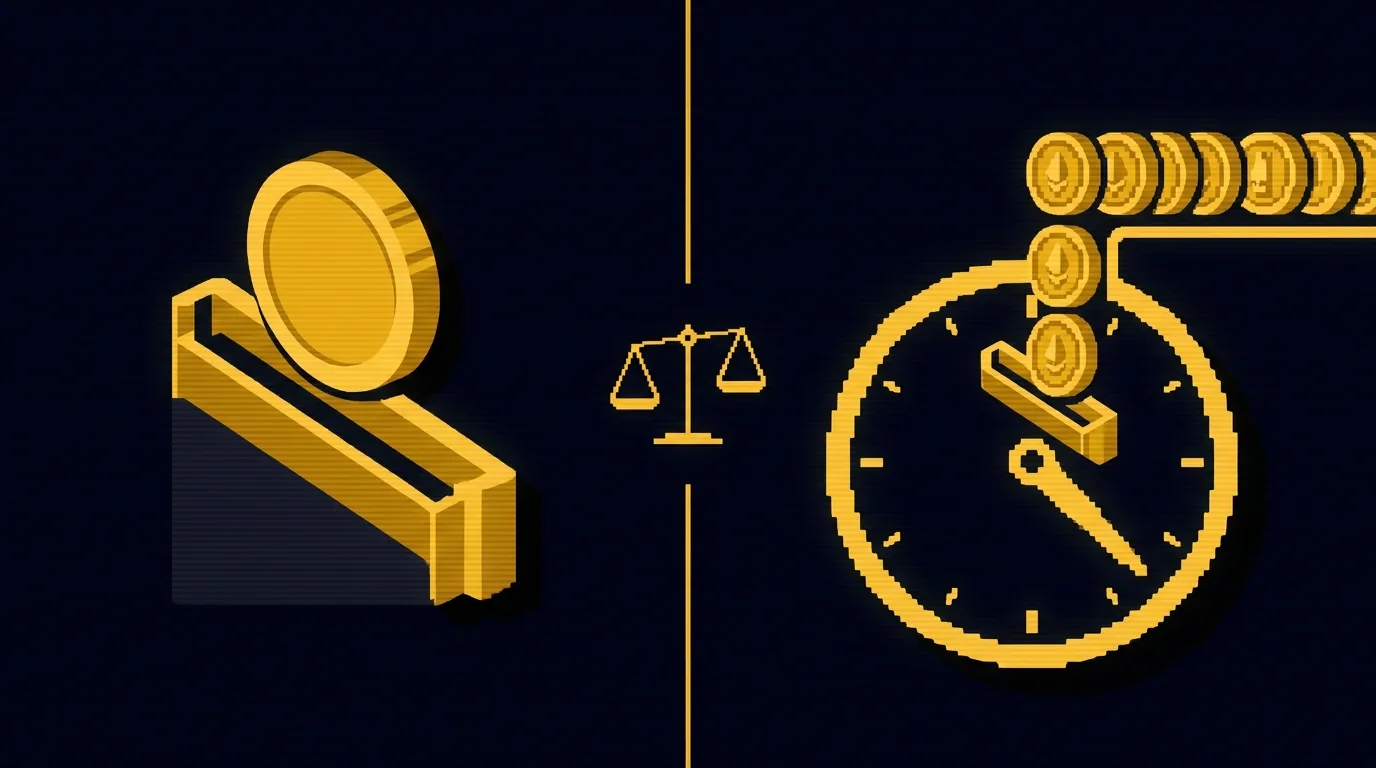
Ask a room of indie builders whether to charge once or monthly and you get two confident camps. The subscription camp points to compounding revenue. The one-time camp points to buyer fatigue and the quiet revolt against another monthly bill. Both are right about the upside and quiet about the cost.
What follows is not a verdict. It is the tradeoff laid out so you can choose for your product instead of inheriting someone else's conclusion.
What each model actually gives you
A one-time purchase is a transaction with a clean end. The customer pays, gets the thing, and the relationship is settled. You recognize the revenue once. There is no renewal to chase, no churn curve to project, no dunning email sequence when a card expires. The buyer's mental model is simple: I bought this, I own it, I am done.
A subscription is a relationship with no clean end. The customer pays repeatedly, and your revenue compounds as long as they stay. You recognize a little revenue each month, which smooths the graph and makes the business easier to forecast. But the relationship never settles. Every month the customer re-decides whether to keep paying, and every month some of them decide not to.
The compounding is real, and so is the re-deciding. Most pricing debates only mention the first.
The hidden costs of subscription
The costs that get quiet treatment are the ones that hit a solo or small team hardest.
Churn becomes your dominant metric. With one-time pricing, a customer who leaves does not hurt the revenue you already booked. With subscription, every cancellation is a future revenue loss you have to replace. You start spending real time on retention before you have enough customers to retain.
Trust debt accrues faster. Buyers in 2026 are saturated with subscriptions they do not use and cannot easily cancel. A new monthly charge carries a built-in suspicion. Your product page has to overcome not just "is this worth it" but "will I resent this in month four." One-time pricing starts from a more trusting baseline.
Operational weight grows. Subscriptions need a working cancellation flow, proration logic, plan changes, expired-card recovery, and a dunning sequence. Each one is a small amount of code and a large amount of edge-case handling. One-time purchase has none of it. The difference is not theoretical: it is the gap between a checkout that works and a billing system you have to babysit.
Refund policy gets harder. A one-time refund is a single reversal. A subscription refund involves prorated periods, partial usage, and the question of what happens to access after cancellation. The more states your subscription has, the more refund scenarios you support, and each one is a support ticket waiting to happen.
The hidden costs of one-time
One-time pricing has its own quiet costs, and they are the reason people migrate to subscription in the first place.
Revenue caps per customer. Each buyer pays you once. To grow, you need new buyers, forever. There is no upgrade path that compounds, no expansion revenue, no "raise the price and the existing base pays more." Your growth is a function of acquisition, not retention.
No funding for ongoing costs. If your product has real per-customer running costs - server compute, API calls, storage, email sends - a one-time payment has to cover the lifetime cost of that customer. Price it too low and a successful launch becomes a liability: every new user adds cost without adding revenue. This is the trap that kills one-time-priced hosted products.
Maintenance has no revenue line. You will maintain the product for years. Bugs, OS updates, dependency CVEs, new devices. With subscription, maintenance is funded by the active base. With one-time, maintenance is funded by new sales, and the day sales slow, maintenance becomes a cost you absorb.
How to actually decide
The decision rests on one question: does your product have ongoing per-customer cost?
If yes - hosted software, anything with a server bill that scales with users, AI features with per-query API costs - subscription is not a preference, it is the honest model. One-time pricing on a product with recurring costs is a bet that you will sell enough new units to cover the old ones, and that bet has lost a lot of indie builders a lot of money.
If no - downloadable software, a book, a static guide, a self-hosted tool, anything where the cost of serving the 1,000th customer equals the cost of serving the first - one-time pricing is the cleaner offer. It matches the cost structure, it matches buyer expectations for that category, and it removes a layer of operational code you do not need.
The middle case is the hard one: a product that has some per-customer cost but also a large one-time-value component. Here, a hybrid often works. A one-time purchase for the permanent parts, a subscription for the hosted or continuously-updated parts. The hybrid is more code and more explanation on the pricing page, but it lets each part be priced honestly.
A practical test
Before you commit, write down the answer to three questions:
- What does it cost you to serve one more customer for one year? Put a real number, including API, hosting, and support time.
- What is the honest one-time price that covers that one-year cost plus your margin?
- What is the honest monthly price that, over the customer's likely stay, covers the same?
If the one-time price in question two is one a buyer would pay without flinching, one-time is viable. If it is high enough to cause friction, subscription spreads the same revenue across payments that feel smaller. If you cannot estimate the per-customer cost in question one, you are not ready to pick a model. Work that out first, because the pricing model has to match the cost structure, not your preference for how the revenue graph looks.
The decision
- Subscription compounds revenue and adds churn, trust debt, and real operational weight. The compounding is the visible upside; the rest is the hidden cost.
- One-time is simpler and more trusted, but it caps growth per customer and funds maintenance only through new sales.
- Match the model to the cost structure, not to the revenue graph you prefer. Recurring per-customer cost points to subscription. Fixed or near-zero marginal cost points to one-time.
What this does not settle
This post covers the model choice, not the price itself. Setting the number is a separate question that depends on your category, your audience's reference prices, and what comparable products charge. The model decision comes first, because the wrong model makes any price unsustainable. For the full pricing and monetization setup, including how to wire Stripe Checkout for either model, The Handbook covers it with worked examples.

Field reports
Log in to submit a field report.
Loading reports…