Between June 9 and August 14, 2026, eight labs shipped 15 headline models: Claude Fable 5, Grok 4.6, GLM-5.3, Qwen3.8-Max, DeepSeek V4, and ten more. That is one release every 4.4 days, each announced as the best one yet with the strong hint that you are behind if you have not switched. That cadence is the engine behind AI model fatigue, and it is not calibrated to you.
The argument in three moves
The rest of this post is the evidence for three claims:
- The calendar moves faster than the capability does. Two of the newest flagships are retrained versions of their own predecessors.
- The cadence serves the labs, not you. A release buys attention, attention buys usage, and usage buys data and revenue. The loop runs whether you participate or not.
- You can run your own loop instead. Own your prompts, evals, and workflow in version control, and gate every model swap on your own eval set. Then a release becomes news, not a work order.
A release calendar is not a capability curve
The per-model deep dives are here too, Qwen3.8 Max for builders and Kimi K3 for builders who ship. The question behind those reviews is the one this post answers: what do you do with the calendar itself.
Start by reading the calendar for what it is, because the calendar is the honest part. GLM-5.2 shipped on June 16 as an open-weight model with a one-million-token context window. GLM-5.3 arrived on August 14, 59 days later, and most of the gap between the two is packaging: it is a post-trained version of the same GLM-5-generation base, not a new-scale model.
The headline benchmark did move, DeepSWE 1.1 from 44 percent to 66.9 percent, and that is a real gain. The part the announcement leads with less: GLM-5.2 was open weight, and GLM-5.3 shipped with no weights at all, gated behind a subscription. For anyone building on GLM-5.2, that is not an upgrade notice. It is a terms change.
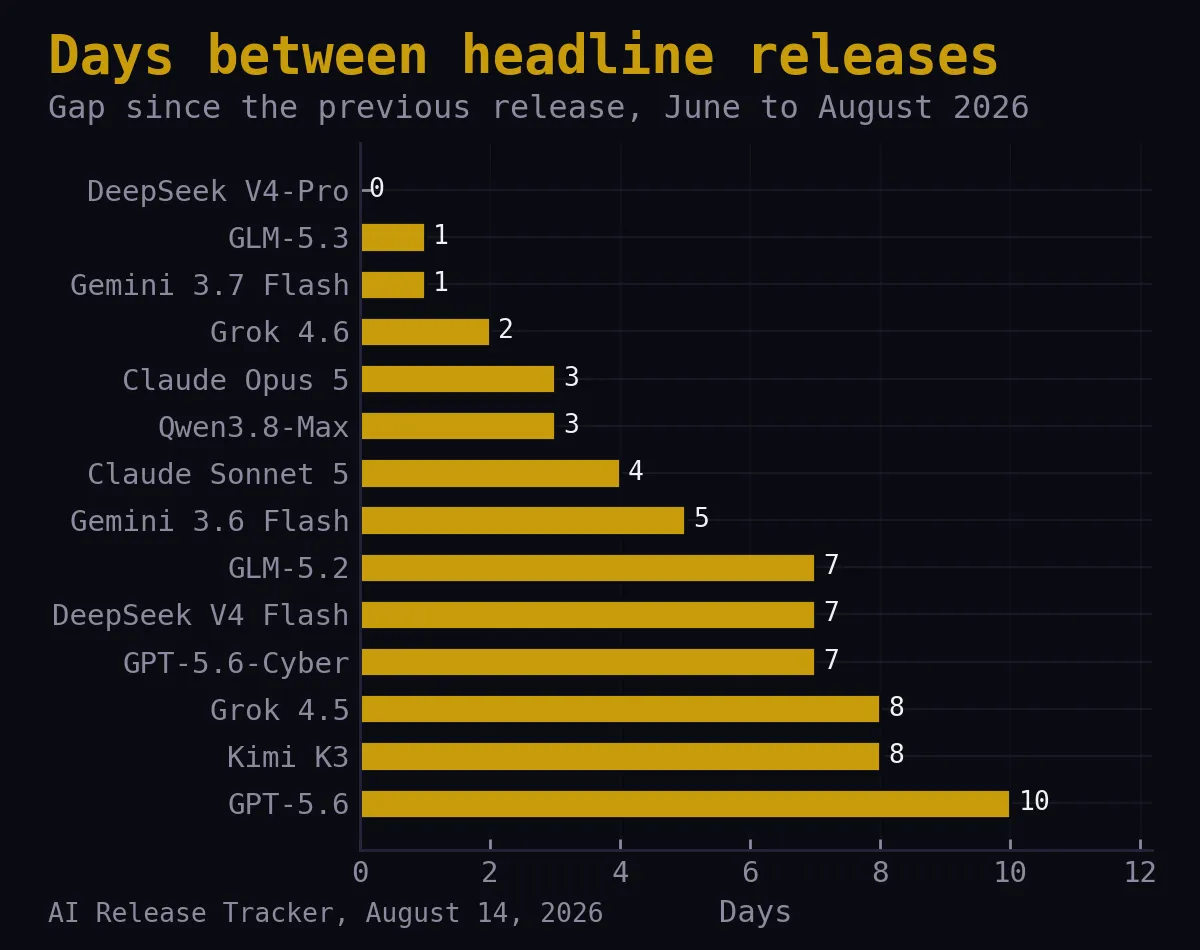
Days between consecutive headline releases, June to August 2026. Fourteen gaps sum to 66 days, and two of the releases landed on the same day (August 13). Source: AI Release Tracker company pages, August 14, 2026.
Grok 4.6, two days earlier, is the same shape from another lab. 35 days after Grok 4.5, SpaceXAI shipped a post-trained version of the same 1.5-trillion-parameter base. The independent Artificial Analysis index moved from 56 to 61. The price did not move: $2 per million input tokens, $6 per million output.
And the arena's own framing of the launch was not "new champion". It was "on par with GPT-5.6 Sol xHigh (1622 pts) and Claude Fable 5 (1627 pts)", all three landing "in the #5-7 rank range with only 4-9 pts of separation", per Arena.ai.
Zoom out and the whole frontier tier is compressed. As of August 14, the text arena has rank one at 1506 Elo and rank ten at 1489. 17 points across the top ten. Every "best model this week" headline happens inside that band.
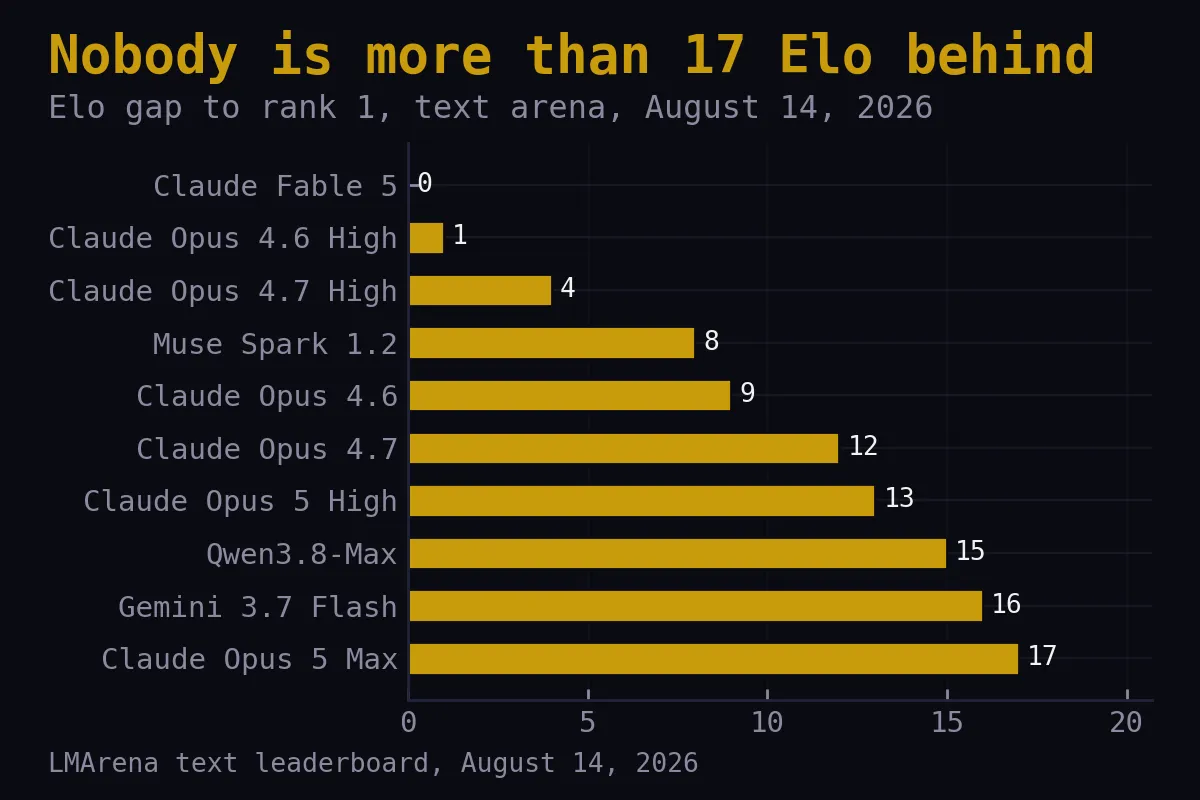
Elo behind rank 1 on the text arena, August 14, 2026. Every step between rank 1 and rank 10 is single digits. Source: LMArena text leaderboard, August 14, 2026.
The trap is reading the calendar as a capability curve and your own status as a position on it. "Newest" is a fact about the calendar. "Best for your work" is a claim nobody has measured except you, and the next two sections show who the cadence serves.
What the churn is for
If the cadence is not about capability, what is it about? One week in August answers the question, and it happened in public.
- On July 31, DeepSeek shipped V4 Flash in public beta: a 284-billion-parameter mixture-of-experts model with MIT-licensed weights and $0.14 per million input tokens against $0.28 per million output, per the official pricing page. The cheapest capable agent token on the market, so harnesses moved their default traffic to it.
- On August 1, OpenCode measured 8 trillion tokens processed in a single day on its surfaces: 5 trillion on the free tier, 3 trillion on the paid lane, roughly 96 percent cached input, per the measurement writeup.
- On August 6, DeepSeek warned of a "significant" API price increase.
- On August 16, peak and off-peak billing takes effect: $0.44 per million input tokens at peak, more than triple the launch price.
Nobody did anything unusual. Cheap model, free volume, usage data, then monetization, is the standard funnel. The free tier was never a gift. It bought scale and telemetry, and the price step followed in six days.
AI model churn is that loop, repeated across eight labs at once: release, attention, free usage, usage data, revenue, funding, next release.
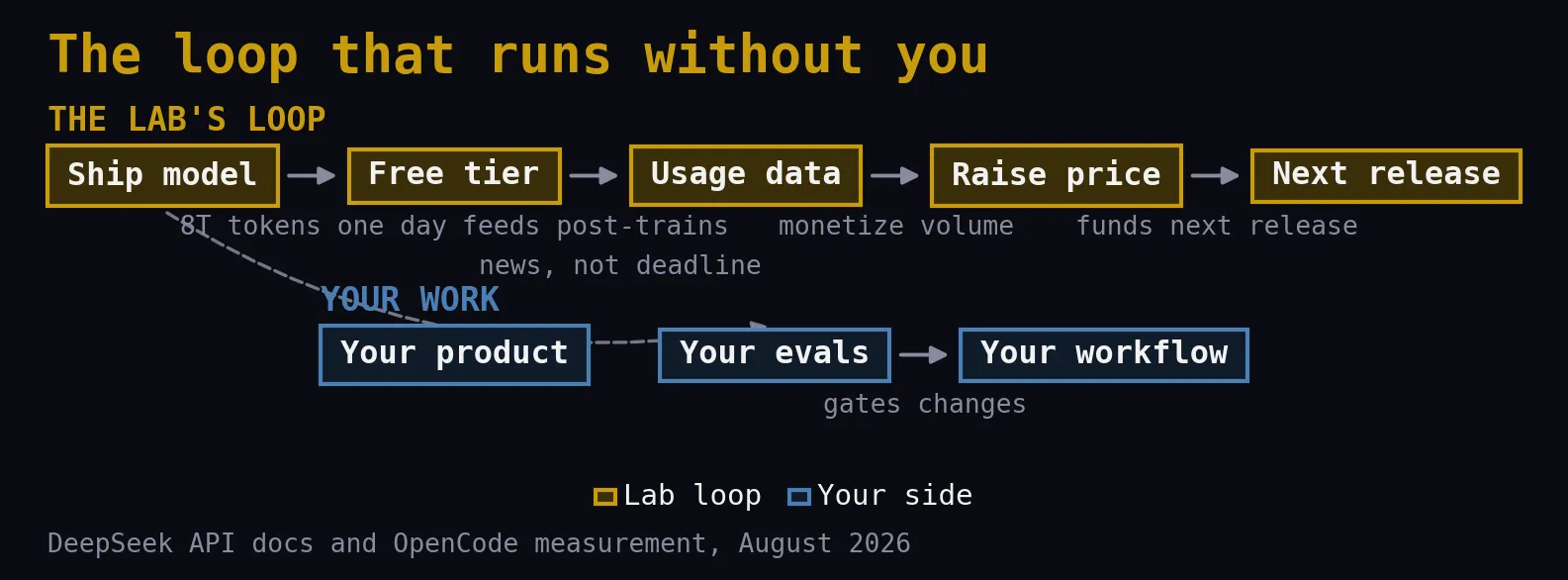
The lab's loop runs with or without you. The only edge into your lane is news, and that edge is optional. Source: DeepSeek API docs and the OpenCode measurement, August 2026.
The same pressure shows in what "open weights" now means. Qwen3.8-Max promised weights a week after its August 3 launch. They arrived August 12: text-only, no vision, no one-million-token context, thinking mode always on, under a reported revenue-share license, with the promised 27-billion-parameter sibling still missing, as covered in the open-weights followup. GLM-5.3 and DeepSeek V4 Pro shipped no weights at all. "Open" now means whatever the license file says, and the file keeps shrinking the deal.
Notice what is missing from every step of that loop: your product. Nothing in it requires you. You are the usage statistics.
The benchmark is not the bill
The business story explains the cadence. The benchmarks explain the size of what you are missing, and it is smaller than the announcements suggest.
On August 12, Bug Hunt Bench v10 seeded 105 real bugs across two repositories and ran 13 frontier models against them, with an independent judge scoring blind. 51 of the bugs survived every model.
The rest of the results are a pricing lesson, not a ranking: GPT-5.6 Sol at maximum effort fixed 82 bugs for $69.61. The same family's cheap Luna tier fixed 64 for $1.80. Claude Fable 5 at maximum effort fixed 34 for $104.49, the most expensive run on the chart. The effort dial and the token burn decide the bill. The model name mostly decides the press release.
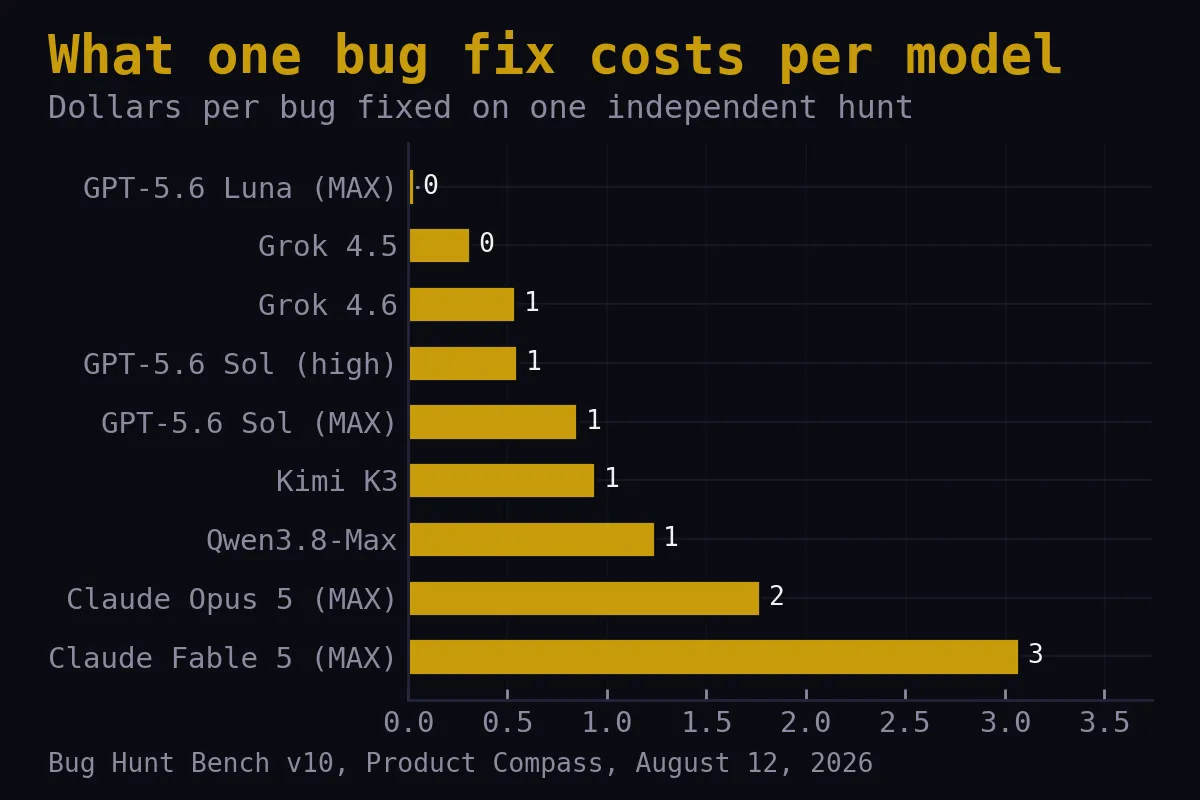
Cost per bug fixed on Bug Hunt Bench v10, computed as cost divided by bugs fixed. Effort tier and token burn decide the bill, not the model name. Source: Bug Hunt Bench v10, August 12, 2026.
This is why the fatigue is aimed at the wrong target. Siddhant Khare, whose essay on AI fatigue earned 471 points on Hacker News, put the cost of chasing releases plainly: "Each migration cost me a weekend and gave me maybe a 5% improvement that I couldn't even measure properly." The weekend is real. The five percent is a guess, and the measuring never happened. A benchmark delta you cannot see in your own work is a rumor about your work.
One more number to hold on to. Vendor-published and independent scores on the same benchmark name diverge by roughly 20 points, per the harness comparison Morph publishes, and Qwen3.8-Max launched with no benchmark table at all.
When a benchmark saturates, each release headlines a new test. Grok 4.6's launch claimed number one on five different tests at once, per its launch table. Different tests, not different capabilities.
Own the workflow, rent the model
Here is the working rule that makes the rest of this manageable. Split your AI setup into three layers and treat them at different speeds:
| Layer | What it is | How often it changes | Who decides |
|---|---|---|---|
| Model | the weights behind the API | every few days | the lab |
| Tool | editor, CLI, harness | every few weeks | the vendor, with your consent |
| Workflow | prompts, rules, evals, conventions | when you change it | you |
Models are rentals. Tools are revisitable. The workflow is the part you own, and owning it is unglamorous: every piece that makes your work yours lives in version control, outside any vendor.
Start with an eval set, a folder of 20 tasks from your own product:
evals/
  01-refactor-payment-flow.md
  02-fix-flaky-test.md
  ...
runs/          # logs, one per model run
Nothing heroic. A refactor you did last month, 3 bugs with known diffs, 5 prompts where you know the correct answer. Building the set costs an afternoon. Maintaining it costs ten minutes per new task.
When a release tempts you, run the set through both models before you decide:
# Compare a new model against your eval set in one pass.
NEW_MODEL="openrouter/qwen/qwen3.8-max"
mkdir -p runs
for task in evals/*.md; do
  name=$(basename "$task" .md)
  if opencode run --model "$NEW_MODEL" --task "$(cat "$task")" > "runs/$name.log" 2>&1; then
    echo "PASS $name"
  else
    echo "FAIL $name"
  fi
done
The loop works with any CLI agent (claude -p, codex exec, whichever you already use), and at current prices a full pass costs cents to a few dollars. The experiment is cheap. The unplanned weekend migration is the expensive part, which is exactly backwards from how most builders run it.
Then the rule: switch only when the challenger beats your incumbent on your tasks by a margin you can measure, and switch between tasks, never mid-task. Swapping a model mid-conversation throws away the cached context and often degrades the output below either model alone.
That is the whole discipline. Judgment still matters on top of it, and the judgment part is a hard skill worth keeping sharp: read the code AI writes.
When a switch is worth it
Concrete triggers for when to switch AI models, and the four non-triggers that trick most builders. A "measured margin" means several tasks in your eval set that only the challenger solves:
| Switch when | Do not switch when |
|---|---|
| your evals show a measured margin | the leaderboard rank moved |
| a pricing or licensing event hits you, like the DeepSeek peak rates or a license change | the announcement said it is the best |
| a capability your workload genuinely needs ships, like vision input or a longer context | a peer migrated |
| your tool drops the model you depend on | it has been a few weeks |
Staying still is a position, and it has a budget. Last generation gets cheap: GLM-4.7, one generation old, runs $0.60 per million input tokens and $2.20 per million output, and GLM-4.7-Flash is free. The labs keep repricing the models you already know, and for most tasks that is exactly what you need.
The scan that costs you five minutes
For the news itself, you do not need alert apps or a daily ritual. AI model fatigue feeds on the feeling that tracking everything is a duty. Five minutes, once or twice a week, and you are covered:
- Open the AI Release Tracker latest page and skim the names.
- Glance at one leaderboard to see whether the top band moved.
- Read one daily roundup, a newsletter or a news thread, and close the tab.
Simon Willison tracks every release in depth because it is part of his job. It is not part of yours.
Where to spend the time you save
The honest loose end: you cannot opt out of the news, and you should not. The models matter, the deltas are real, and a genuine step-change would show up in your eval set long before you felt left behind. What you can change is who schedules your work. The hours that used to go to migrations go back to the product, and to the eval set that makes your next decision for you.
If this discipline sounds familiar, it is the same one The Handbook applies to the rest of the build, deploy, and ship path: workflow you own, tools you can swap, claims you verify. The handbook does not chase model releases either. It teaches you to build, deploy, and ship real software with AI, and to keep the judgment for yourself.
Field reports
Log in to submit a field report.
Loading reports…