The year Amazon's CEO told employees that AI would "reduce our total corporate workforce", the company's revenue grew 12% to $717 billion and its operating income grew 17%. Both facts come from Amazon's own documents. Hold them side by side and the AI layoffs story starts to wobble. A company riding double-digit growth does not shed engineers because AI made engineers productive. It sheds them because it decided to need fewer of them.
Three findings before the evidence, so you know where this lands:
- The best dataset on AI and jobs shows reduced hiring, not replacement. Through June 2026, separations have not risen. The measurable change is that the entry-level ladder lost rungs.
- The companies blaming AI for cuts made moves against employee bargaining power in the same window: office mandates, assigned desks, fewer managers, cheaper replacement hires.
- The companies that build AI are hiring engineers at $250,000 to $1.5 million per seat, and they ban AI assistance in their interviews.
The claim, stated plainly: the AI layoff wave is not a productivity story. It is a bargaining-power story. Engineers will recognize the phrase in the title: inversion of control. During 2021 and 2022, the dependency pointed one way - companies needed engineers who could quit and double their salary elsewhere. The past two years rewired it. AI obsolescence is the publicly acceptable reason; control is the consistent variable.
What AI layoff announcements share
The announcements share a genre.
Mark Zuckerberg, on the Joe Rogan Experience in January 2025: "Probably in 2025, we at Meta, as well as the other companies that are basically working on this, are going to have an AI that can effectively be a sort of midlevel engineer that you have at your company that can write code."
Marc Benioff, on the 20VC podcast in December 2024: "We're not adding any more software engineers next year because we have increased the productivity this year with Agentforce and with other AI technology that we're using for engineering teams by more than 30%."
Andy Jassy, in a memo to Amazon employees in June 2025: "We will need fewer people doing some of the jobs that are being done today, and more people doing other types of jobs... we expect that this will reduce our total corporate workforce as we get efficiency gains from using AI extensively across the company."
The shared shape has three parts:
- An inevitability claim: AI is coming for a tier of engineer, and the timeline is now.
- A productivity number, asserted rather than audited: 30% more velocity, work equivalent to hundreds of agents.
- A headcount conclusion presented as physics: the number follows from the technology, so nobody had a choice.
The physics does not hold: a 30% productivity gain at a growing company means more output per engineer, not fewer engineers. The same executives pair the framing with promises that contradict it. Benioff said Salesforce would "probably be larger" in five years and hire 1,000 to 2,000 salespeople. By August 2026, a Salesforce community publication was running a piece titled "Salesforce's Hiring Boomerang: Why Are Ex-Employees Coming Back Now?" The engineers were not obsolete. They were expensive, mobile, and confident, and employers had started to price that against them.
The data shows fewer rungs, not fewer workers
If AI were replacing current engineers, payroll data would show it the direct way: more separations. That is not what the numbers show.
Economists Erik Brynjolfsson, Bharat Chandar, and Ruyu Chen track millions of US payroll records through ADP in the Stanford Digital Economy Lab's Canaries in the Coal Mine? study, revised in August 2026 with data through June 2026. Their six facts, condensed:
- No evidence of widespread, economy-wide job displacement.
- Employment of workers aged 22 to 25 in AI-exposed occupations stands 19% below where it would be if it had tracked their less-exposed peers. Experienced workers in the same occupations show no comparable gap.
- The gap has widened steadily since it was first documented in August 2025.
- It operates through reduced hiring of young workers, not increased separations.
- Where AI use complements workers, employment is flat or rising, especially for experienced workers.
- The adjustment runs through employment, not base pay.
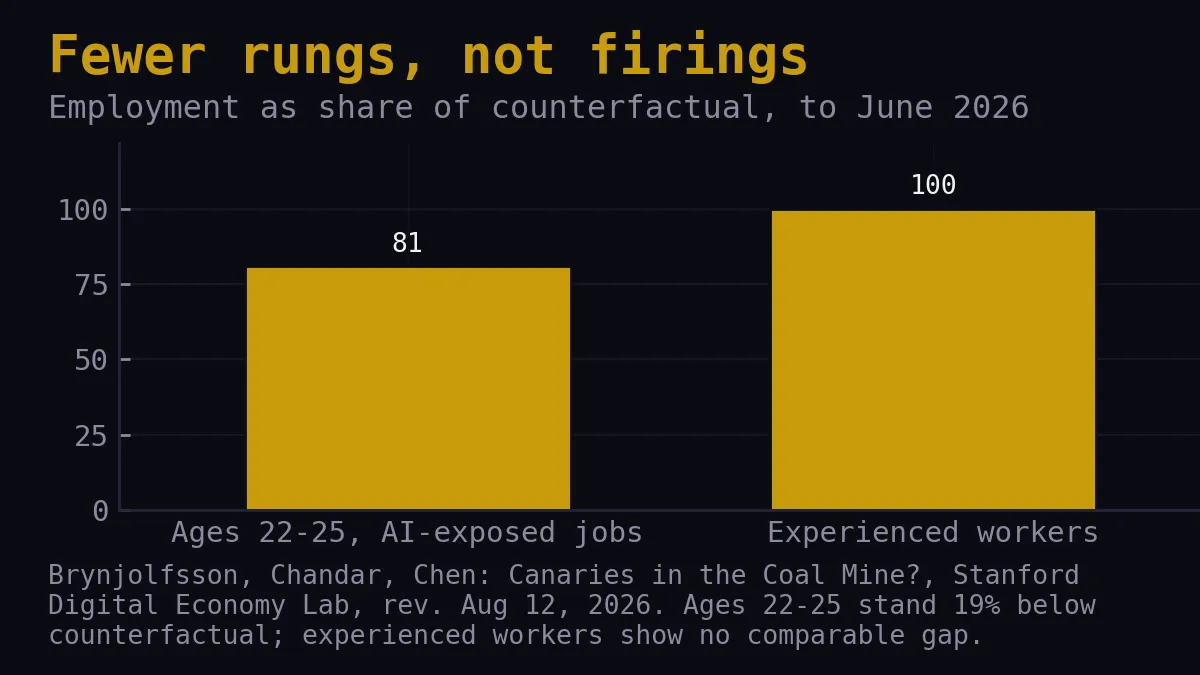
Reduced hiring, not firings. Experienced workers are plotted at parity (100) because the study reports no comparable gap for them, not because 100 is a measured value. Source: Brynjolfsson, Chandar, Chen, Canaries in the Coal Mine?, Stanford Digital Economy Lab, rev. Aug 12, 2026.
Read the mechanism closely; it separates two different labor markets. Replacement means incumbents get fired and their roles disappear. Reduced hiring means incumbents stay and the door behind them closes. The data shows the second. Companies stopped adding juniors; they did not start firing seniors at any measurable rate. Whatever the announcements say about AI replacing engineers, the payroll records describe a hiring freeze shaped like a technology claim.
Who is hiring while others cut
Now flip to the companies with the most at stake in whether AI can do an engineer's job. If anyone could justify freezing hiring on AI-productivity grounds, it is the labs. They are doing the opposite.
Anthropic listed roughly 526 open roles in August 2026. The company passed 2,500 employees in January 2026, with more than 1,300 in the Bay Area, and took over a 480,000 square foot office tower in San Francisco. Revenue run rate: $87 million at the start of 2024, $9 billion at the end of 2025.
OpenAI listed 752 open roles the same month: about 4,500 employees by March 2026, up from roughly 770 in November 2023, with a stated plan to reach around 8,000 by year end.
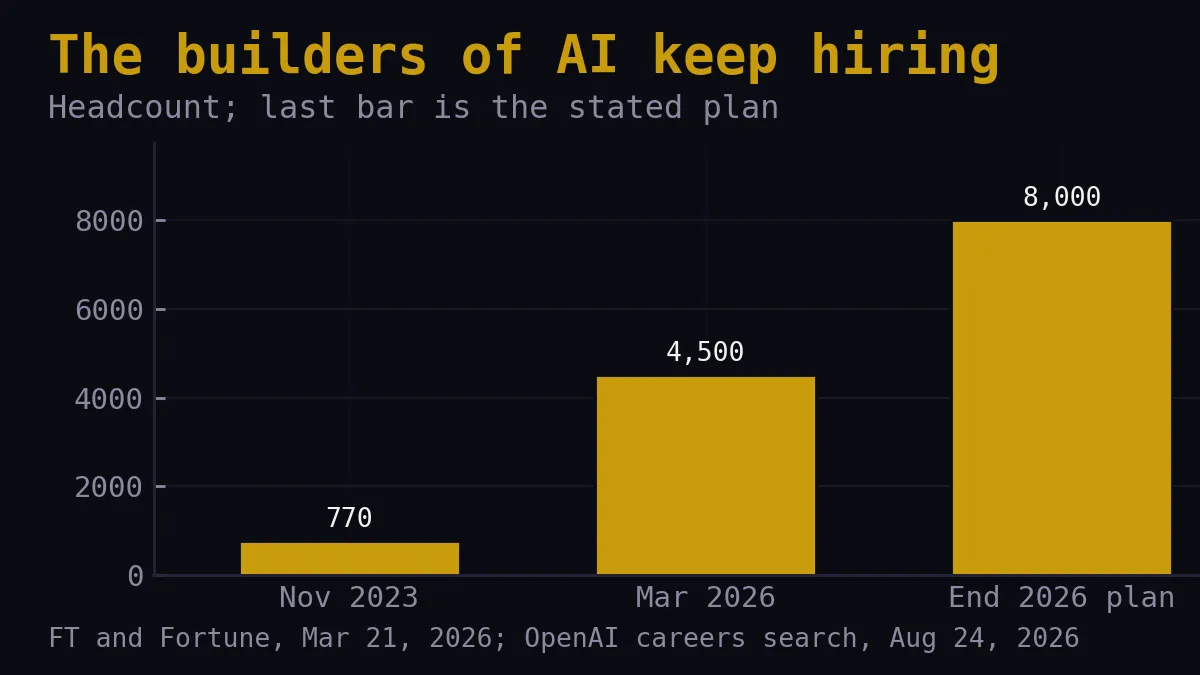
The builders of AI more than double their headcount during the layoff wave. Source: FT and Fortune, Mar 21, 2026; OpenAI careers search, Aug 24, 2026.
The pay tells you the labs mean it. Levels.fyi, updated August 2026, puts Anthropic software engineer compensation between $367,000 at entry and $1.25 million at staff, median $850,000. OpenAI's band runs $253,000 to $1.52 million across levels. These are not severance budgets.
Here is the detail that cuts hardest against the obsolescence narrative: the interviews. Anthropic publishes candidate AI guidance that every applicant acknowledges. For live interviews it says: "This is all you - no AI assistance unless we indicate otherwise." Take-home assessments: "Complete these without Claude unless we indicate otherwise." Technical rounds use live coding tools and test whether you are "comfortable with basic syntax and standard libraries". OpenAI's published interview guidance, as candidate reports summarize it, describes multi-hour technical rounds where you walk through systems you built and defend the trade-offs. The companies closest to the technology test whether you can think without it.
Sam Altman's framing at a January 2026 town hall makes the point with a hedge: hiring will slow, he said, but "keep hiring", and OpenAI is "nowhere close to doing away with human employees entirely". Dario Amodei wrote in October 2024 that, short term, comparative advantage "will continue to keep humans relevant and in fact increase their productivity". The people with the best view of AI capability are bidding up human engineers. Treat that as data.
The control moves in the same memo cycle
Back to Amazon. No company documents the pattern more completely.
In September 2024, Jassy sent employees a memo with two announcements. First: corporate staff return to the office five days a week from January 2025, assigned desk arrangements included, because "before the pandemic, it was not a given that folks could work remotely two days a week, and that will also be true moving forward". Second: every organization must raise its ratio of individual contributors to managers by at least 15% by the end of the first quarter, because "having fewer managers will remove layers and flatten organizations".
Nine months later came the June 2025 memo: AI will "reduce our total corporate workforce".
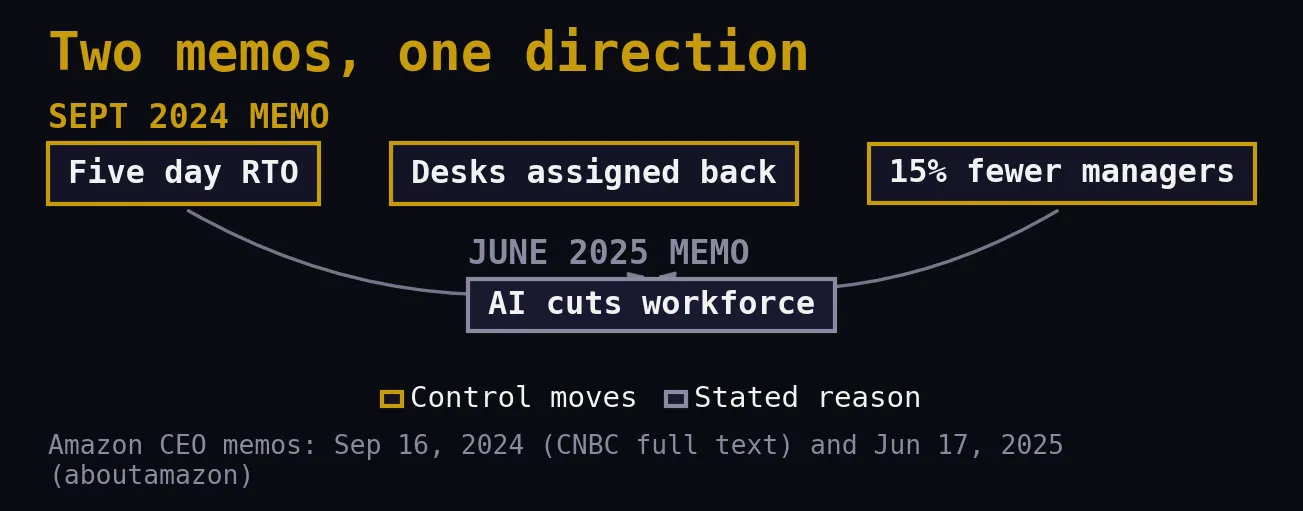
Two memos, one direction. Source: Amazon CEO memos, Sep 16, 2024 (CNBC full text) and Jun 17, 2025 (aboutamazon).
Then the April 2026 shareholder letter closed the loop: revenue up 12%, operating income up 17%, and free cash flow down from $38 billion to $11 billion, driven by a $50.7 billion jump in capital spending on AI infrastructure, with roughly $200 billion planned for 2026. Amazon did not cut corporate roles because it could not afford engineers. It cut them while redirecting the budget toward datacenters and chips. The engineers were not unaffordable. They were outbid, internally, by capex - and the AI framing made allocation sound like physics.
Klarna ran the same arc faster. In February 2024 it announced its AI assistant handled the work of 700 customer service agents. In December 2024 the CEO said hiring had stopped because AI "can do all of the jobs". By May 2025, Klarna was recruiting humans again - remote roles, "competitive pay and full flexibility" - and the CEO admitted cost had become "a too predominant evaluation factor": "what you end up having is lower quality". The chatbot kept its two-thirds share of routine chats throughout. The claim that collapsed was not the automation. It was the idea that the humans were gone for good.
Five questions before you believe an AI layoff
The next announcement will land with the same shape. Run it through these questions first:
- Are revenue and profit growing while headcount falls? Growth plus cuts means allocation, not survival.
- Did separations rise, or did openings close? Replacement fires incumbents; power plays freeze the ladder behind them.
- Did office mandates, desk assignments, or manager ratios change in the same quarter? That is the control agenda announcing itself.
- Who is being hired instead, and at what pay? Same work at lower pay is a bargaining move wearing a technology costume.
- Does the productivity number survive arithmetic?
| Signal | Reads as restructuring | Reads as power play |
|---|---|---|
| Revenue and profit trend | Falling demand forces cuts | Record results alongside cuts |
| What the payroll data shows | Separations rise in automated roles | Openings shrink, incumbents stay |
| Replacement hiring | Nobody rehired; the work disappears | Same work rehired cheaper or more compliant |
| What ships alongside | Severance, org change, nothing else | RTO mandates, assigned desks, manager ratio targets |
| What AI-native companies do | They would cut too; they would know first | They hire at $250K to $1.5M and ban AI in interviews |
| The productivity claim | Published and auditable | Asserted once, never audited |
What this means if you build software
- The market's revealed preference is the frontier lab interview: system design, live coding, trade-off reasoning, no AI assistance. Whatever the tools can do, the buyers of engineering judgment still price the fundamentals. If your AI-assisted workflow has quietly replaced the skill underneath it, that is the gap to close, starting with reading the code AI writes.
- Complement the tool where you work. The Stanford data shows employment flat or rising where AI complements experienced workers. Owning the system - the interfaces, the failure paths, the decisions - is that side.
- The junior ladder narrowed by about 19%, so entry strategies built on credentials alone are weaker than strategies built on shipped work.
- Fear is the product being sold in this market, and it is priced into every offer you accept. Decisions made from it - a 30% pay cut accepted out of gratitude, a specialty abandoned - outlast the cycle that produced them. The discipline that helps is the one AI model fatigue asks for: own your workflow, judge claims on your own evals.
Where the burden of proof sits now
Three observations would disprove this argument. If the frontier labs freeze engineering hiring, the counter-evidence dies and obsolescence becomes the better reading. If separations start rising in occupations where AI complements workers, replacement has arrived and the payroll data will show it plainly. If companies cutting "because of AI" leave remote work, desk assignments, and manager ratios untouched, the control story loses its spine.
None has happened as of August 2026. What has happened is a two-year stretch in which every AI layoff announcement arrived next to a memo about offices, org charts, or budgets, and the companies with the clearest view of AI capability kept buying engineers at record prices. When the stated reason and the revealed behavior diverge this consistently, believe the behavior. And if you want to be on the complement side of this shift - using AI as an amplifier rather than negotiating from fear of it - the free preview chapters show how working builders do it.


Field reports
Log in to submit a field report.
Loading reports…